Market Stall or Village Hall: Two Shapes for a Local Fair
Market stall or village hall: see how weather, circulation and layout shape conversation and browsing, then choose a fair setting that suits its purpose.
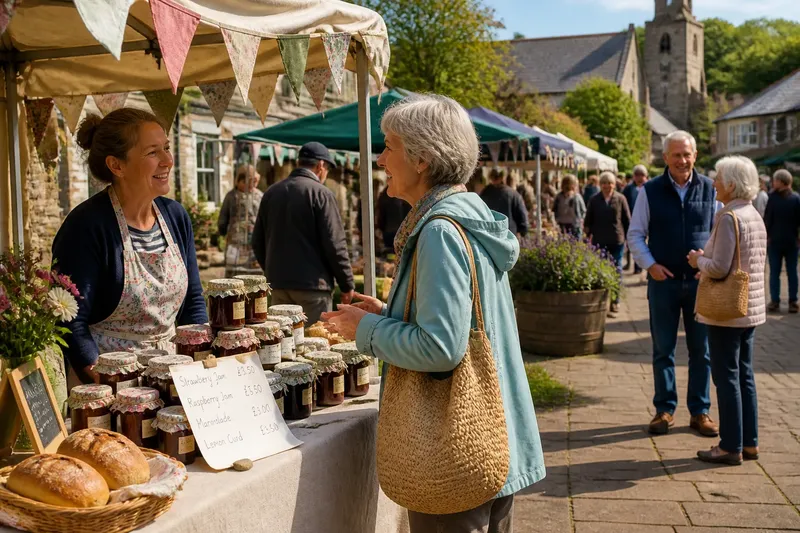
At an open-air fair, a gust lifts the corner of a handwritten price card while someone pauses to greet a neighbour beside the jam stall. At the village hall, the same greeting might happen in a doorway, with a queue forming behind it. Market stall or village hall is not just a choice between fresh air and shelter: each setting gives a fair a different rhythm, shaping how visitors move, browse and talk.
Neither format is automatically more welcoming. The useful question is what kind of encounter the organisers hope to make possible, and what the site can comfortably support. A market setting encourages people to drift between visible stalls; a hall gives them a bounded room in which to linger. That difference affects stallholders as well as visitors.
How does an open-air market shape a fair?
A row of stalls offers a clear invitation to walk along it. Visitors can spot colour, signs and activity from a distance, then approach the displays that catch their eye. The route is often legible without a map: follow the line, pause, turn back, or step away to make room. If the fair occupies a familiar market square or a stretch of pedestrian street, the setting can also make it feel part of ordinary local life rather than a separate occasion.
Open space makes movement flexible, but less predictable. A popular stall can draw a loose knot of people; a wide gap between tables can leave a quieter seller feeling detached. Wind, passing pedestrians, uneven paving and changing daylight all affect how comfortable it is to browse. These are not reasons to avoid an outdoor fair, but they belong in the layout conversation from the start.
Conversation tends to happen in short, passing exchanges. A visitor may ask what is in a jar, notice a familiar name, then continue along the row. Stallholders can call out a welcome or speak with someone while still watching the flow. That suits fairs built around spontaneous discovery, where visitors are likely to arrive and leave at different times.
Outdoor stalls also make a fair visible to people who did not plan to attend. A passer-by may stop because of a hand-painted sign, the smell of baking or the sound of a small music group. The same openness can make the event feel exposed if there is little shelter or if the site is beside a busy road. Organisers should consider where people can step aside, sit down or take a quieter route without blocking the browsing line.
What does a village hall change?
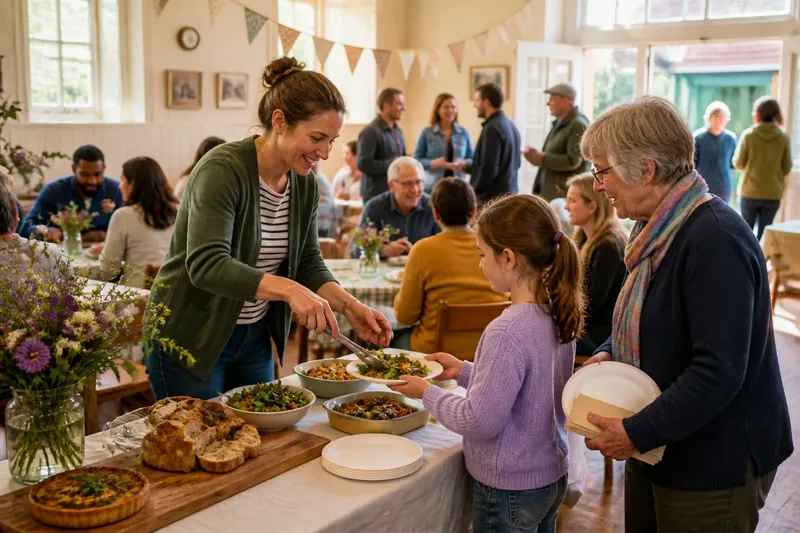
A hall gathers the event inside a defined boundary. Visitors come through a door, encounter a room, and can usually see that the fair has a beginning and an end. Tables can be arranged around the walls, in parallel rows or in a loose circuit. A clear entrance and visible central aisle help people understand where to go, while a seating area gives companions a place to wait without hovering beside a stall.
The enclosure can make conversation easier to sustain. A visitor who stops to ask about a handmade object is less likely to be swept along by foot traffic, and a stallholder can demonstrate or explain without competing with passing noise. The room may also support a shared programme, such as a short performance or a tea table, because visitors are already gathered within earshot.
But a hall concentrates sound and movement. A busy doorway can become a bottleneck, especially when people pause to greet one another or remove coats. Closely spaced tables may make browsing feel like squeezing past rather than choosing freely. The room’s shape matters: pillars, low light, a narrow corridor or a door that opens directly into a stall can all influence the experience.
Indoor fairs can feel welcoming to visitors who prefer a sheltered, contained setting, including people who want somewhere to sit or take a break. They can also feel less inviting to someone who sees a crowded room through the entrance and decides not to go in. A simple welcome at the door, a visible sign showing the route and an uncluttered place to pause can make the threshold feel less abrupt.
Which layout best supports browsing and conversation?
Think of a fair as a route with places to stop, rather than a collection of tables. In a market, the route is often linear, so the organisers can use spacing and sightlines to keep movement flowing. In a hall, a loop or broad central aisle can prevent visitors from having to double back through a tight crowd. Either way, a stall should be visible from the approach, and a person stopping to talk should not block the next visitor’s path.
Say a village group is planning a fair with a potter, a baker and a local history table. If it takes place in the market square, organisers might place the history display near a quieter edge, where visitors can read without standing in the main line, and keep food away from a route where people are carrying hot drinks. The expected result is a browsing path with room for both quick stops and longer conversations. If the same fair moves into a hall, the group might place the history table beside seating and keep the entrance clear; that arrangement gives readers somewhere to pause without forming a queue across the doorway.
Displays need not all face the same way. A stall angled towards a walkway can invite people in, while a table set across a narrow route can make it difficult to pass. In a hall, leave a clear approach to doors and shared facilities. Outdoors, avoid relying on signs or display items that could be shifted by wind or obstruct the public route.
Consider the pace you want. A fair designed for browsing can leave room between stalls and offer more than one way around. A fair centred on conversation may benefit from seating, a demonstration area or a small gathering point away from the busiest stretch. These features work best when they do not force every visitor to take part in the same activity.
What should organisers check before choosing a site?
- Visitor flow: Walk the likely route from arrival to exit. If people would have to cross a queue to reach another stall, adjust the entrance or layout.
- Stopping space: Identify where a visitor can pause without obstructing others. If there is nowhere to stop, reduce the number of tables or create a separate resting area.
- Shelter and comfort: For an outdoor site, consider shade, wind exposure and a sheltered place to take a break. For a hall, look at ventilation, lighting and whether the room may feel crowded.
- Access and thresholds: Check the approach, entrances and routes through the site. If any part is difficult to reach or pass through, consider a different layout or venue and seek suitable local advice where needed.
- Sound and conversation: Notice nearby traffic, music, kitchen activity or echo. Place conversation-led displays away from competing noise where possible.
- Stall needs: Ask what each seller needs for display, storage and customer interaction. If a particular stall cannot function comfortably in the proposed space, revise the arrangement before confirming it.
- Arrival and leaving: Look at where visitors will come from and where they can go afterwards. If arrivals would gather in a narrow entrance or on a busy path, make a clearer approach or choose another location.
For access, fire safety, permissions and any restrictions on selling or serving food, follow the venue’s instructions and relevant local rules. A site’s suitability depends on those requirements as well as its atmosphere.
Who is each fair setting likely to suit?
An open-air market often suits an event that wants to meet people in a familiar public place, welcome casual passers-by and keep movement loose. It can work well when stalls are visually distinct and visitors are expected to browse at their own pace. It may be less suitable if the fair depends on quiet conversation, delicate displays or a settled indoor programme, unless the site can provide appropriate shelter and space.
A village hall often suits a fair that needs a defined gathering place, seated pauses or a programme that brings people together at particular moments. It can give sellers a more contained setting and help visitors stay longer. It may feel cramped if the number of stalls exceeds the room’s comfortable capacity, or if people must share a narrow entrance and aisle.
Some communities have a third option: a hall opening onto a courtyard or paved forecourt. This can divide the event into two moods, with busy browsing outside and quieter displays or seating indoors. It also asks more of organisers, who need to make the connection between the spaces obvious and ensure that visitors do not miss one side of the fair.
How do you choose between a market stall and a village hall?
Start with the fair’s main purpose, not with the venue that feels most traditional. If the aim is to catch the attention of passers-by and encourage short, informal stops, an open-air market may fit. If visitors are meant to settle in, talk at length or attend a shared activity, a hall may be the better shape. Then test that preference against the route, room or site, and the needs of the people using it.
Ask stallholders where they need visitors to stand, what they want people to notice from a distance, and how much space a conversation takes. Ask visitors whether they are likely to arrive in groups, with children, or for a short visit between other errands. These answers do not dictate a single format, but they can reveal whether the proposed layout matches the fair’s intended pace.
Market stall or village hall is a choice about the kind of attention a local fair invites. The market lets visitors encounter one stall after another as part of a shared public route; the hall makes a room for them to enter and occupy together. A clear route, somewhere to pause and a welcoming threshold matter in either place. Choose the setting that makes those ordinary acts easiest for the people the fair hopes to bring together.