The Old-Custom Myth: Traditions Can Change
Traditions can change without losing their purpose. Learn how a community can adapt a familiar custom while keeping its meaning recognisable.
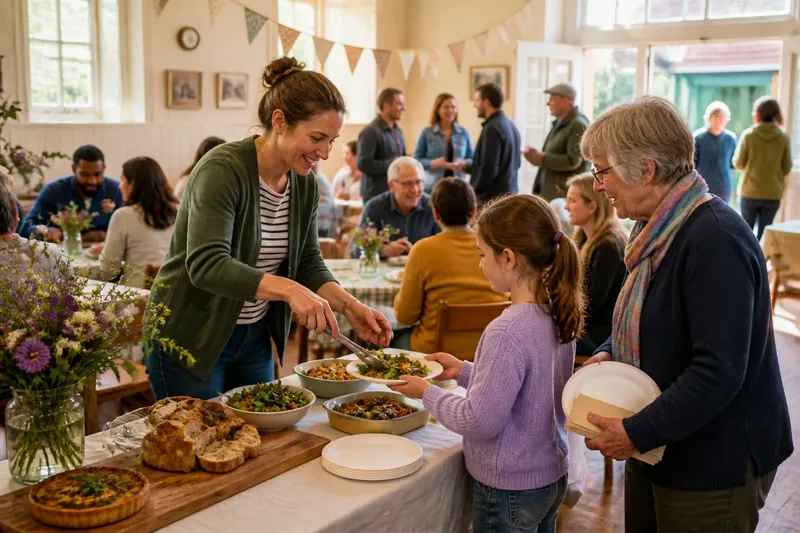
At the village hall, someone sets out paper plates beside the familiar wooden serving board. The annual welcome supper has changed its tableware, its menu and the hour it begins, yet people still arrive to greet neighbours and make room for newcomers. Traditions can change without becoming empty; the useful question is what a practice continues to do for the people who keep it.
The old-custom myth treats age and sameness as proof of authenticity. It can make ordinary adjustments feel like betrayals, even when the original circumstances have disappeared. A custom is not a sealed object handed down intact. It is a repeated act, renewed by people who decide what belongs in it now.
What makes a tradition recognisable?
A tradition usually has a recognisable purpose, a pattern people can anticipate, and a shared understanding of who may take part. Those elements need not depend on every detail staying fixed. A procession may still mark a seasonal turning if its route changes to include an accessible street. A communal meal can welcome the neighbourhood even if local cooks alter the dishes.
It helps to distinguish the custom’s purpose from its familiar trimmings. The purpose might be to honour a place, pass on a skill, welcome a new household or give neighbours a reason to meet. A particular song, costume or recipe may express that purpose, but it is not automatically the only possible expression.
That distinction should not become an excuse to discard whatever is inconvenient. A detail may matter because people have attached memories or responsibilities to it. Ask what a feature means before deciding whether it can change.
How can a community decide what to keep?
Begin with conversation, not a vote on whether a custom is “authentic”. Ask regular participants, people who have stopped attending, younger residents and newcomers what they understand the practice to be for. Listen for differences: one person may value a shared meal, another the chance to teach a local song, and another the simple fact that the gathering happens every year.
Then make the choices visible. A short note in the hall or a notice beside the event can explain what remains, what is changing and why. This is not a defence brief; it gives people a way to understand the decision and correct a mistaken assumption. If a change affects a group that has not been heard, pause and invite them into the discussion.
- Name the purpose: describe what the gathering or practice gives the community.
- Identify the familiar parts: note the actions, objects, words or places people expect.
- Ask who is missing: consider who cannot join easily, and why.
- Separate memory from obligation: make room for affection without treating every old detail as compulsory.
- Explain the change: tell participants what will be different and what is being carried forward.
Say a neighbourhood’s lantern walk has always ended at a narrow footbridge, but some residents cannot use that route. Organisers could ask participants what the ending signifies, then move the final gathering to the nearby square while keeping the lantern-making and shared walk. The expected observable result is that people still make and carry lanterns together, while more neighbours can join the closing moment.
What can a season of change look like?
A deliberate adaptation does not have to be rushed. A season gives organisers time to listen, try one manageable change and notice how participants respond. The rhythm below suits a recurring community custom, from a seasonal gathering to an annual procession.
At the start of the season: listen before proposing
Gather recollections and practical concerns in ordinary settings: after a club meeting, during a shared meal or through a conversation at the local shop. Ask people to describe what they would miss if the custom disappeared, and what makes it hard to attend. Keep the questions open; a leading question can turn consultation into a request for approval.
In the middle of the season: choose one change
Use what you have heard to identify a single adjustment that serves the custom’s purpose. It might be a different meeting time, a new route or an invitation for another group to contribute. Leave other elements alone for now, so participants can tell what has changed and discuss that change clearly.
Before the gathering: make the reason plain
Share the plan through the channels people already use: a noticeboard, a community newsletter, a message from the organisers or a conversation at a regular meeting. Say what will happen, what will remain familiar and whom to contact with concerns. If the change depends on local permissions, venue rules or instructions from an organiser, check those before making the announcement.
After the gathering: ask what people experienced
Do not judge the adaptation only by turnout or by whether the event ran smoothly. Ask whether the custom still felt like itself, whether more people could take part, and whether any unintended difficulty arose. Record the answers so the next group of organisers inherits the reasons behind the decision, not merely the new arrangement.
When does a change risk losing the custom’s purpose?
A change deserves closer thought when it removes the very action people gather to perform, makes participation harder for those the custom is meant to include, or shifts control away from the community without discussion. These are not automatic reasons to reject change. They are signals to ask whose purpose is being served and whose account has not been heard.
There is also a difference between adaptation and a superficial rebranding. Giving an event a new name while leaving its access barriers untouched may alter its appearance without changing its welcome. Conversely, a modest practical adjustment can have deep meaning if it lets more people share in the central act.
Disagreement is not necessarily a sign that the custom has failed. People may hold different memories of it, especially when a practice has changed gradually over time. A calm account of those differences can be more truthful than a single story claiming that everyone remembers the same original version.
How should a community explain a changed tradition?
Does a changed custom become less authentic?
Not simply because it changes. Its authenticity rests less on reproducing every detail than on whether participants can recognise and take part in its shared purpose.
Should every traditional element be preserved?
No element should be treated as untouchable before its meaning is understood. Some details carry memory or identity; others may be practical habits that no longer serve the gathering.
How can organisers involve people who rarely attend?
Ask them directly through familiar local channels, and offer ways to respond that do not require attending another meeting. People who have drifted away may explain obstacles that regular participants no longer notice.
What should organisers do if people disagree?
Make the reasons and trade-offs clear, and distinguish concerns about the custom’s purpose from preferences about its details. If an important group has not been heard, seek their views before settling the change.
A tradition stays recognisable when people know why they gather and can see that reason in what they do. Its inherited details deserve attention, but so do the neighbours who need the custom to make room for them. When explaining how traditions can change, describe both the part that continues and the practical choice that lets it continue.